Discover
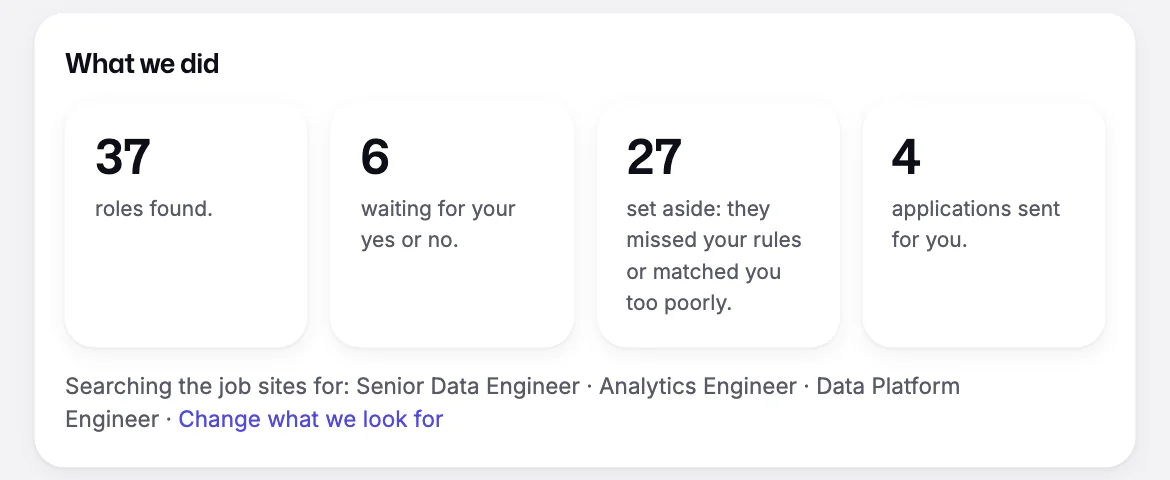
Monitors the sources you select — job boards, company career pages, ATS listings and hiring platforms.
Upload your résumé — that's all the typing you'll ever do. The agent finds roles that genuinely fit, submits each application and proves it on the wire: the submit request, the employer's response, the screenshots. Every reply lands in a mailbox it keeps for your search.
Free beta — no credit card, evidence included.
You find the role on a board, on a company page, anywhere at all. You click Apply and land on yet another form asking for everything you have already written down. Paste that page's link here: the agent fills it in, attaches your résumé, submits, and records the submit and the response that came back.
It works on the company's own form. On platforms that require a candidate account of their own, such as InfoJobs, Gupy, Sólides and Wellfound, the agent registers and maintains that account itself. LinkedIn is the one it never touches.
Auto-apply tools stop at the form. find-best-job keeps working after you apply — the part of the job hunt that actually gets you hired.

Monitors the sources you select — job boards, company career pages, ATS listings and hiring platforms.

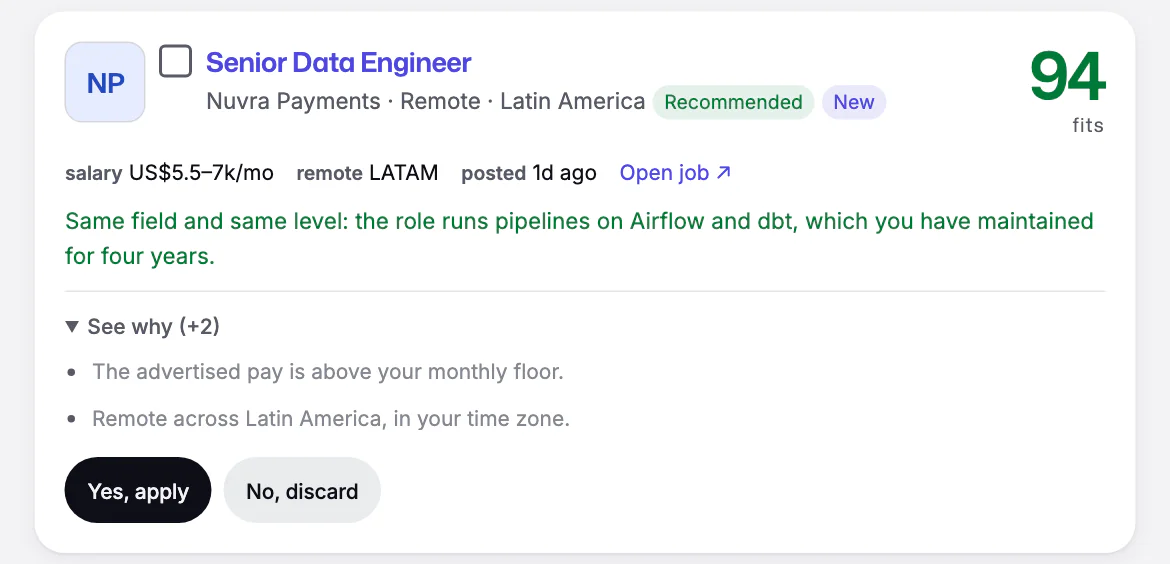
Checks each role against your pay, location, seniority and the criteria you set. Low fit never gets applied to.

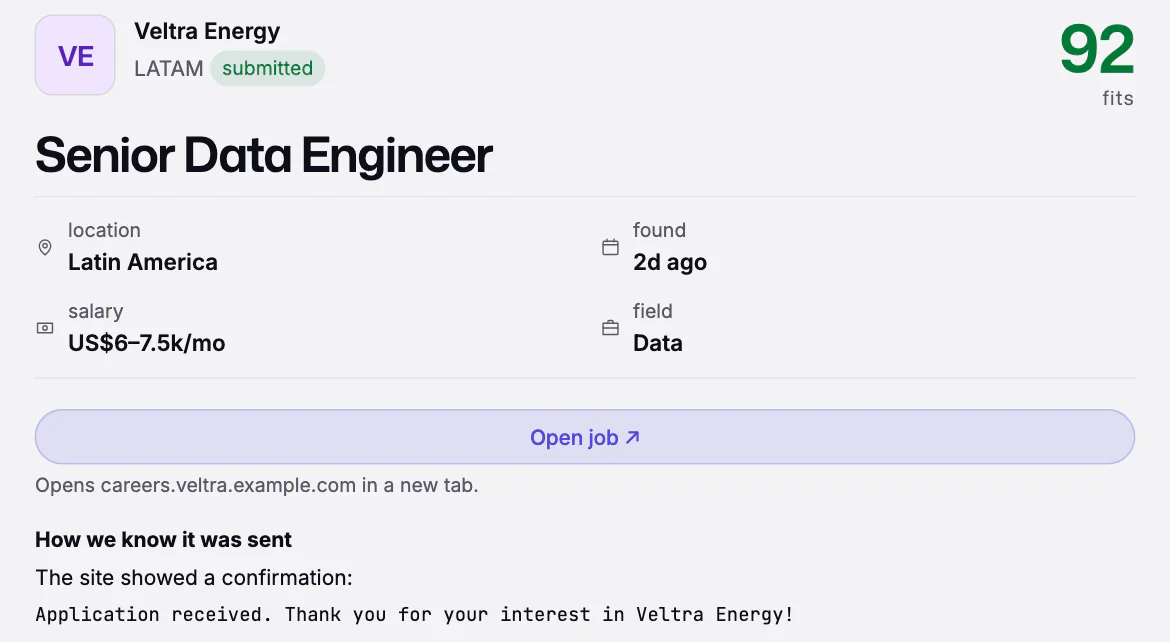
Fills and submits the real form — everything extracted from your résumé, nothing typed by you. Screenshots prove every submit.

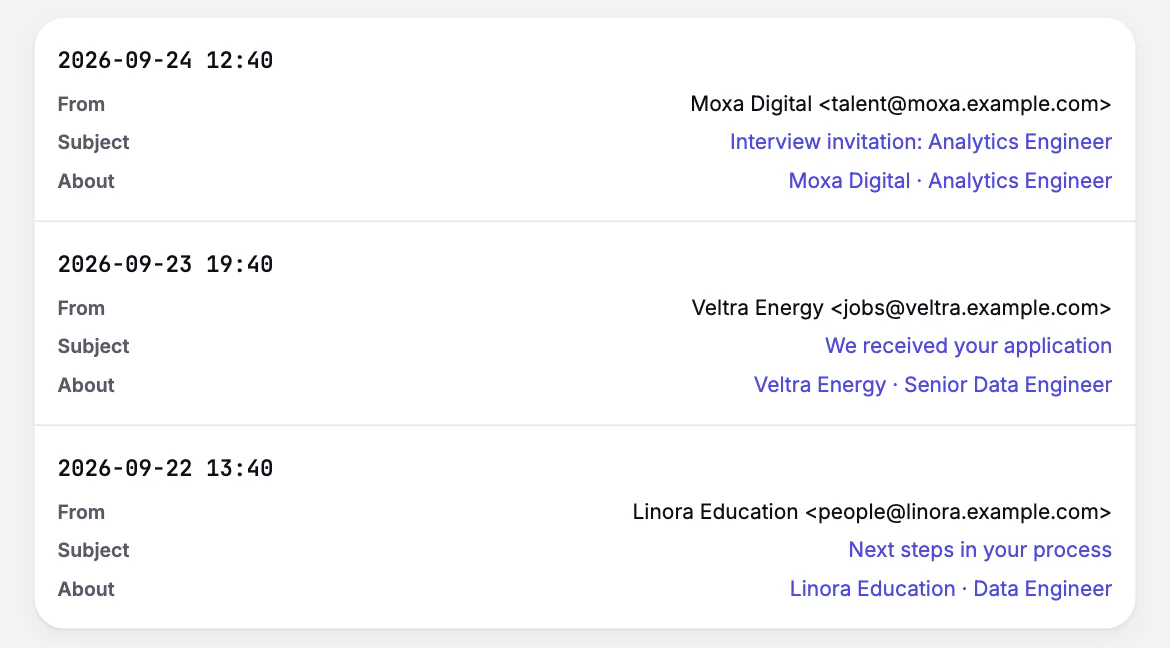
A dedicated mailbox receives confirmations, rejections and recruiter replies. The agent reads and files each one, and drafts your answer from your own facts — you send it.
Upload your CV and find-best-job reads a first set of filters straight out of it — seniority, stack, where you can legally work. You correct what it got wrong; nothing is applied to until it matches what you asked for.
Every line above is a field you can change.
Move the pay floor, add a city, exclude a company — the next run obeys immediately. A role that comes close without convincing waits for your yes.
Mass auto-apply is spam — recruiters can tell. find-best-job behaves like a diligent candidate: few applications, high fit, everything documented. The mechanism is dull on purpose: hard daily caps, and a review queue where a role that does not convincingly fit waits for your yes. And the searching is free: on the free plan the agent still goes looking every day and scores what it finds — you pay for volume, not for being looked after.
The agent extracts everything from your CV — no forms, no questionnaires. Cover letter and extra answers are optional, and everything stays editable.
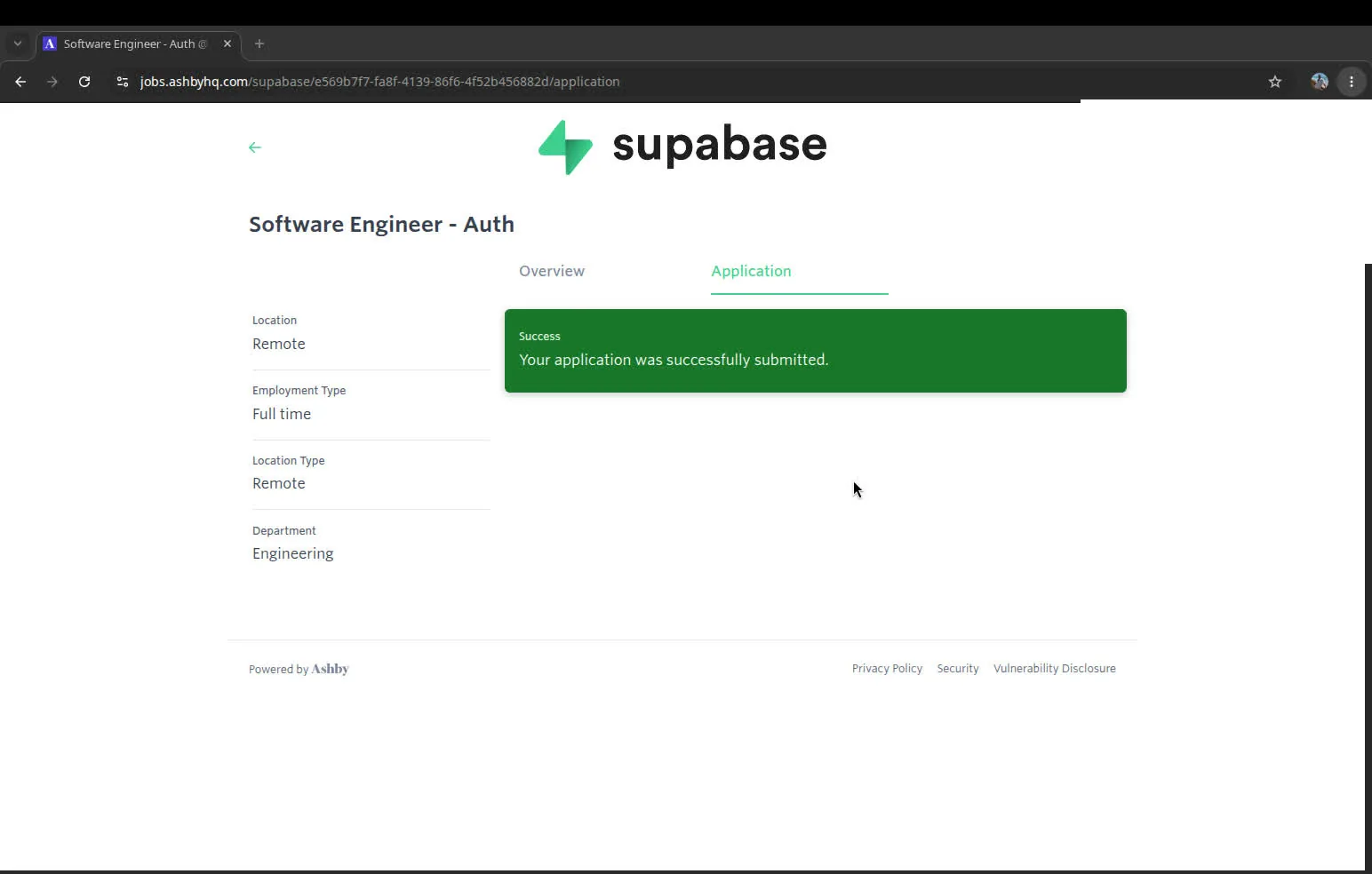
The submit is verified on the wire: the agent records the request the employer received and the status that came back, next to pre- and post-submit screenshots, the full answer log and a per-job timeline. Nothing is deduced from how the page looked.
You define the search, whatever you do and wherever you are — on-site, hybrid or remote, one city or worldwide. Your rules decide.
The agent creates an email address just for your search and uses it to register on hiring platforms. Every employer reply is read, classified and filed against the right application.
Answers come from your profile and your canonical Answer Library. Work authorization, salary expectations, availability — your words, always.
Not a paid extra: on the free plan the agent hunts every day, scores up to 60 new roles a run against your profile, and submits one of them for you. Discovery reads the job boards, Indeed included; the application goes out on the employer's own form — Greenhouse, Lever, Ashby, Workday, Workable. Where a platform requires a candidate account of its own, such as InfoJobs, Gupy, Sólides, Wellfound or arc.dev, the agent registers, keeps that account alive and applies natively. LinkedIn is the one account it never touches.
Connect find-best-job to your AI assistant and ask it in plain words. It sees the roles that matched you today, answers what you want to know about them, and sends an application when you tell it to.
Any new remote frontend or backend roles in Brazil?
Two came in today and both clear your salary floor:
Want me to apply to the first one?
You are handing an agent your résumé, your answers and your platform logins. Here is exactly what happens to them.
Logins the agent creates or uses are sealed with AES-256-GCM before they touch the database, decrypted only inside the process signing in for you, and never rendered back to a screen.
Every screenshot, résumé and document is stored under a key belonging to your account, and every request for one is checked against the rows that are yours. A hard-to-guess id is not an access control.
The database is KMS-encrypted and unreachable from the internet, and the artifact bucket blocks all public access. Leaving takes no email to us either: the danger zone in your dashboard settings exports everything you have, or deletes the account outright, on the spot.
It answers only from your résumé and the answers you approved. When a form asks something it cannot support — work authorization above all — it stops and tells you rather than guessing.
The submit itself is captured on the network: the request that carried your application, and the status the server answered with. It is stored alongside screenshots before and after, the log of what was typed into which field, and a timeline per application — you never have to take our word for what was sent.
We use Microsoft Clarity to learn where the interface confuses people. Everything inside the dashboard is masked before it is recorded — replays show us the layout you struggled with, never the contents.
We do not sell your personal data. Our subprocessors are named in the privacy policy, along with what each one receives.
Free is not a trial. The agent looks for roles and scores them for you every day, forever, and sends one application a day on your behalf. Pro is what you buy when one a day stops being enough.
Annual billing saves 15% — pay yearly and get Pro for US$24.65/month (US$295.80/year). Nothing is charged while the beta is on.
Yes. The agent opens the real application form in a real browser, fills every field with your data, uploads your résumé and clicks submit. Then it records what actually went over the network: the submit request, and the status the server answered with. Screenshots of the page before and after are stored with it, so an application counts as sent only when the wire says so.
Any application page on the web: Greenhouse, Lever, Ashby, Workable, Workday, other ATSs and company career sites. Job boards — Indeed among them — are read as discovery sources. And where a platform requires a candidate account of its own, such as InfoJobs, Gupy, Sólides, Wellfound or arc.dev, the agent registers with email and password, keeps that account alive and applies natively. LinkedIn is the single exception: we never sign in there.
No. We read Indeed and other boards to find roles, but the agent never signs into your account on either — both platforms suspend accounts for automation. Applications go out on the employer's own form, or through a candidate account the agent created and owns itself on the platforms that require one.
No — any profession and any kind of job: on-site, hybrid or remote, wherever you're looking. You define the search; the agent applies where you fit.
Because it is checked on the network, not guessed from the page: the agent records the submit request and the status the employer's server returned, and files it with a screenshot right before, one right after, the full answer log and timestamps. If a submit fails, it is retried automatically and every attempt keeps its own evidence.
No. Answers come exclusively from your profile and your canonical Answer Library. If a form asks something the agent can't answer truthfully from your data, it asks you instead of guessing. It will never claim a work permit or qualification you don't have.
The opposite. The agent applies to at most 10 roles a day, and only ones that pass your fit rules. Each application is filled carefully with your real answers. It looks — and is — indistinguishable from a diligent human candidate.
The search itself, which is the part most tools charge for: from day one the agent goes looking on its own, scores up to 60 new roles per run against your profile, and sends one complete application for you per day — 20 a month — with full evidence. You can also paste a link yourself and it applies to that one. Employer replies land in your applications mailbox either way. What Pro adds is volume: up to 10 applications a day instead of 1, and discovery bounded by the sources you choose rather than by us.
Nothing. You upload your résumé and the agent extracts everything it needs from it. You can optionally add a cover letter or extra answers, and every piece of information is editable — but none of it is required.
The agent creates a dedicated address for your search and registers on hiring platforms with it, so no employer mail lands in your personal inbox. Everything that arrives is filed against the right application — and when a recruiter needs an answer, the agent drafts it from your Answer Library and you send it yourself.
Yes. Cancel in one click and keep access until the end of the paid period. Landed a job? Pause your subscription and keep your profile and history for the next search.
Yes, on Pro. Connect Claude, ChatGPT, Codex or Grok to your account and ask it there: which roles matched you today, how an application is going, and send that one. You paste one address and sign in on our screen — there is no key to copy. It never sees the passwords we use on hiring platforms.
What we count, what we get wrong, and what the job market actually pays. Real numbers, every week.
116,692 postings from one month, read on 5 September 2026: what each field pays, who says out loud that they hire in Latin America, and where the form lives.
Read →Field by field, on the form 147 employers used last month: what is required, what nobody has to answer, and the three places everyone gets stuck.
Read →Four days on a real search: 360 roles seen, 87% dropped, 9 applications sent with a photo of every submit — and what each one cost us to run.
Read →No waiting list and no card. Create an account, upload your résumé, and the agent applies to twenty real roles for you — with a screenshot of every submit.
Free while in beta. Nothing is applied to until it matches the target you set.